Homepage | Order By Mail | Customer Service | About Us | Shopping Cart | Contact Us

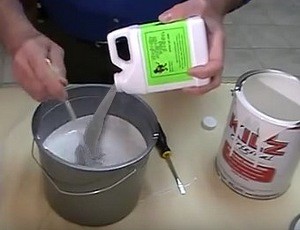
There is a lot more to know about magnetic paint than you can just paint it on your walls and magnets will stick. First, there are different brands of magnetic paint. Some are pre-mixed with primer paint, are quite expensive and can be difficult to stir up to a usable consistency. They go on black or a very dark gray color so they can be hard to cover with light colored finish paints. I invented a dry magnetic paint additive that mixes with white primer. It mixes up easily in seconds and is fresh every time you use it. It goes on white and stays white on your wall. Because it stays white, it covers easily with one coat of any color finish paint. Two coats of any brand magnetic paint are required to get magnets to stick. Many people prefer three or even four coats for maximum magnetic attraction. Personally, I would never use the spray cans of magnetic paint. They can go on too thin to be of much use.
Not all magnets will stick well to magnetic paint on a wall. Cheap magnets, weak magnets and heavy magnets may actually fall right off. I had some plastic letters once that were made in China. They had small plastic magnets in the center of each letter. They were so weak that they would not even stick to the steel door on my fridge. They didn't have a chance of sticking to magnetic paint.
Magnetic paint only attracts magnets because it has millions of microscopic metal particles in the paint. It is these particles that attract magnets, not the paint. The paint only holds the particles on the wall. The more coats of the magnetic paint you get on the wall, the stronger the magnetic attraction of the wall. That is, unless you didn't get the magnetic paint mixed up well enough or didn't keep it mixed up well enough while doing the painting. In the pre-mixed brand, because the metal particles are heavier than the paint, they can settle to a thick, heavy layer on the bottom of the can and sit there for months on the store shelf. When you have the paint store man mix it on his mechanical mixer, it may not mix. The metal particles can stick to the bottom of the can in this thickly packed mud. You may need to chip and scrape it off the can's bottom with a screwdriver and beat it into submission with a paint stick or an electric drill mixer. My Magically Magnetic Paint Additive mixes up instantly and easily in seconds everytime you use it, with just a few seconds of stirring with a simple wooden paint stick. Always remember to stir your magnetic paint again just before adding more magnetic paint to your paint roller tray.
If you want a strong magnetically attractive area to stick the magnets to, magnets like you may already have on your refrigerator door, get a steel panel and adhere it to your wall. Nothing attracts magnets like solid steel. But if you want to have a beautiful magnetic wall to display photos, the kid's art or a million other things magnetically, magnetic paint will do the trick beautifully. You just need to know what you can and can't expect from the materials.
Magnetic paint is made to attract sheet magnets and rare earth magnets. Sheet magnets are the kind of magnets used to make magnetic business cards and magnetic signs for car doors. They stick well because they also have millions of tiny metal particles in them that have been magnetized. Their strength is weak compared to a strong rare earth magnet but they are much larger and very light so they stick well to magnetic paint. Sheet magnet comes in 15 mil, 20 mil, 30 mil and 60 mil thick. The thicker the magnet, the stronger the magnetic attraction. Rare Earth magnets are extremely strong and lightweight. They can actually jump and stick together instantly if they are held close enough and can chip or crack if they smack together hard enough. To avoid this danger, I have designed my Safety Cap rare earth magnets. They all have the same magnetic north pole showing at the bottom and can't jump and smack together face to face. Their magnetic power is used to stick to steel or your magnetic wall.
In summary, mix the magnetic paint well before you paint. Before every coat, mix it up again to keep the metallic particles in suspension in the paint. Particles left in the paint can or in the paint tray don't do your wall any good. Use a 1/4-inch closed-cell foam paint roller to apply the magnetic paint. A regular fiber roller can allow the particles to get trapped in the spaces between the fibers. Again, what gets caught in the roller doesn't end up on the wall. A foam roller is closed cell meaning there is nowhere for particles to get caught. It will produce the smoothest magnetic wall. All magnetic paint will have a slight texture since the magnetic particles don't dissolve in the paint. When the paint dries, the particles will show as a light texture. Tape around the area you want magnetically attractive and paint the magnetic paint inside this taped off area. That will produce a nice clean straight edge around the outside of the magnetic area. When the magnetic paint is dry and you are happy with the attraction to your magnets, remove the tape and finish with a coat of your choice of any color finish paint on the entire wall. This will make a nice looking finished job and the light texture of the magnetic material will be less noticeable. The finish coat of paint also helps to protect the magnetic particles.
If you want to make a magnetic chalkboard wall, don't use a mixture of magnetic paint and chalkboard paint. Paint the magnetic paint first and when it is dry, sand it lightly with 000 sandpaper to get rid of any unwanted high tips of excess texture. You aren't trying to make the wall completely smooth. Then paint two coats of the chalkboard paint as your finish coat.
Magnetic paint is a wonderful product and works very well if you know how to use it. I hope I have added to your knowledge on the subject.
|
Magnetic Grip Clips
As I mentioned before, not all magnets are equal and not all magnets stick well to magnetic paint. Some heavy, cheap or weak magnets that stick pretty well to your solid steel fridge door may not stick at all to magnetic paint. That is because magnetic paint attracts magnets with millions of microscopic metallic particles in the paint. Those particles are thinly spread over the surface and will attract magnets but not as well as solid steel. Two kinds of magnets stick best to magnetic paint, Rare Earth magnets and Sheet magnets. If sheet magnets are used in a way that a large area of magnet will make contact with the magnetic paint, a surprising amount of strength will be observed. I have attached a large plastic clip similar to a chip clip to a large area of heavyweight sheet magnet. The clip is firmly attached to the magnet and the magnet is held firmly to the magnetic paint magnetically. The clip holds a calendar or child's drawing securely on the wall but can be removed and displayed again and again with no change in the magnetic attraction or any marks on the wall. Witness the holding power of Magnetic Grip-Clips on magnetic paint. This large clip holds 3/4 pound of nails while the medium clip will hold 1/2 pound. A thin coat of rubber cement on the backside of the sheet magnet will produce more friction between the sheet magnet and the wall, which will allow the magnet and clip to hold even greater weight without sliding down the wall. |
|
|
Magnetic Wall Mounting Pads
Another way to display paper items is with the use of a rare earth magnet and a disc of steel supported on the magnetic paint with a large sheet of magnet. I have used a 3 by 4 inch sheet of 30-mil magnet and adhered a 1 ½ circular disc of steel, actually a larger thin steel washer, on the front center of the sheet magnet. The sheet magnet holds the steel disc to the wall and the paper is then held securely between the steel disc and a rare earth magnet. This combination will hold stronger than just the rare earth magnet on the magnetic paint and will hold more weight. I have used one of these at each corner of large posters with great success. Again, there are no marks from such an arrangement. In the lower photo we used one of our 1/4 inch thick Safety Cap Rare Earth magnets with a Magnetic Pad. The weight of the nails in the bag being supported on the magnetic paint wall is 3/4 of a pound. Two pads with these rare earth magnets could hold a total of 1½ pounds. Our wall is painted with three coats of Magically Magnetic Paint. More coats would produce an even stronger attraction between the magnets and the wall. |
|
|
Magnetic Wall Mounting Strips
Mounting paper items on magnetic paint is easy using strips of 60 mil white magnetic mounting strips. Use just one strip an inch wide by 12 inches long across the top of a standard 8½ by 11 sheet of paper or use two or three strips across the top for a larger sheet of paper like a poster. You might even want to use a strip or two on the bottom and sides. This material is bright white write and wipe on the front. You can write on it with dry erase markers to label the strips temporarily or with permanent Sharpie markers for longer lasting markings. These permanent markings can also be erased using some denatured alcohol and a paper towel. They can then be reused and re-marked. |
|
|
Rare Earth Magnet holding power
Each 1/8 inch thick Rare Earth Safety Cap magnet can hold 1/5th of a pound on a wall painted with 2 to 3 coats of magnetic paint. This has more to do with the non-skid nature of the back surface of the item being supported than the actual strength of the magnet. In our test, we used a plastic sandwich bag which has a slippery surface and not much friction with the wall. The 1/4 inch thick magnet has twice the magnetic strength of the 1/8 inch thick magnet. Click here to order Rare Earth Magnets In the lower photo we have used our Magnetic Wall Mounting Pads (listed above) with a Rare Earth Magnet thereby increasing the holding power on the magnetic paint three times due to the larger area of the round pad and the greater friction on the wall. Giving the Mounting Pad an even better non-skid back surface by applying a thin coat of rubber cement and allowing it to dry before placing it against the wall surface, will allow the rare earth and pad combination to support even more weight without sliding on the magnetic paint. The rubber cement doesn't stick to the wall. It only produces more friction between the mounting pad's sheet magnet and the magnetic paint on the wall. Back to top |
Magically Magnetic Inc. sells LYTLE Magnetic Photo and Art Frames
exclusively, the smart, easy, fun, modern way to protect and display your favorite photos.
They're the Original and they're the best. Most LYTLE products are protected by US patent
and copyright laws.